For both homeowners and commercial lawn and landscape companies, purchasing a lawn mower is a major decision, one you want to get right the first time. But it can be challenging to pick through the wide selection available and decide exactly what you do and don’t need.
Several factors go into determining what type of lawnmower you buy. Lawn size is a big one, and you’ll also need to take into consideration what kind of terrain you need to maneuver and how much work you want to put into mowing. To help you start narrowing down your options, here’s a quick overview of the major lawn mower styles available.

Robot Lawn Mowers
Pros: automated lawn mowing
Cons: only works in small, flat lawns with continuous grass
Robotic lawn mowers work similarly to robotic vacuum cleaners. To set them up, you install invisible fencing around the yard and set up a charging port for the mower in the yard that’s sheltered from rain. The mower then automatically cuts in a random pattern within the fenced area. They can work well for small yards with uninterrupted grass, but they’re on the expensive side. The main benefits are for homeowners who want to automate mowing in small, flat yards and for commercial crews that are short-staffed and service areas with small, residential yards.
Electric Mowers
Pros: low-maintenance and zero-emission
Cons: only works for very small lawns
You can get corded electric mowers or battery-powered models. Battery-powered electric mowers are more convenient to use, since you don’t have to drag a power cord around, but it’s a good idea to have spare batteries on hand if you don’t want to take breaks to charge a battery. These mowers are very quiet and low-maintenance because of not having a gasoline engine. If you have a small, in-town yard, they’re a good choice. These are also an option for those who live or work in noise-restricted neighborhoods or locations with bans or limits on gasoline engines.
Gasoline Push Mowers
Pros: economical choice for small, flat lawns
Cons: can be tiring to use, especially in hilly lawns
If you want a workout while mowing, gasoline-powered push mowers could be a good choice. They’re typically less expensive than the self-propelled models, but if your lawn is on the larger side or has hills, you’ll want to consider a self-propelled model instead. My husband can attest to the fact that mowing even a small hilly yard with a push mower is extremely challenging (we ended up buying a self-propelled model).
Self-Propelled Walk-Behind
Pros: take the effort out of pushing a walk-behind mower
Cons: best for lawns under 1/2 to 1 acre in size
Self-propelled walk-behind mowers do most of the work for you, even on hills. All you need to do is walk and steer. They also have the advantage of being more maneuverable than larger mowers, including riding mowers. If you have a small yard or one with lots of obstacles to mow around, they’re typically the best choice. For landscaping professionals, self-propelled models make the work go faster in yards that are too small or too cluttered for a big zero-turn mower.
Mid-Size Walk-Behind
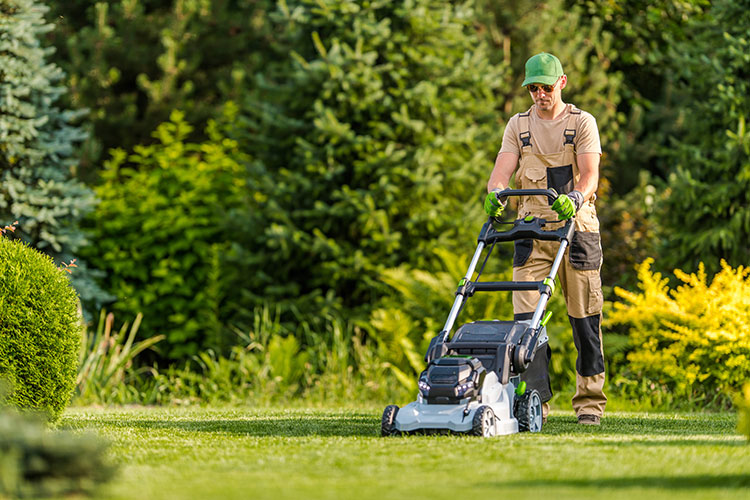
Pros: larger cutting deck than other walk-behind mowers
Cons: you still have to walk
You can’t ride on these mowers, but they mow quickly and cover more ground in each pass than smaller walk-behinds. Often, these larger walk-behind mowers are commercial models designed to handle rugged, daily work. They can handle all terrain, but might not be good for large yards unless you want a vigorous workout.
Stand-On Mowers
Pros: maneuverable, fast, better on slopes than zero-turns
Cons: standing may be less comfortable than riding
Stand-on mowers combine the maneuverability of a zero-turn riding mower with the compact design of a wide-deck walk-behind mower. They are typically more stable on slopes than zero-turn mowers, which makes them good for uneven yards. For lawn and landscaping professionals, these mowers can help save space on equipment trailers because they have a smaller footprint than riding zero-turns.
Zero-Turn Riding Mowers
Pros: fastest lawn cutting available, highly maneuverable
Cons: not good for hilly lawns or steep slopes
If you have a large flat lawn, you can’t beat zero-turn riding mowers for speed. Once you get used to the two-handle steering mechanism, you’ll be able to mow quickly and maneuver with ease around obstacles in the lawn. They’re not the best choice for hilly or sloped lawns, though, because there is a high risk of the mowers tipping or rolling over.
Lawn Tractors
Pros: good for large lawns, can handle hills, multipurpose use
Cons: slower and less maneuverable than zero-turn mowers
Lawn tractors are an all-purpose riding mower. They’ll cut large lawns much more quickly than a walk-behind mower (though not nearly as fast as a zero-turn mower) and can handle different terrain with ease. You can also get attachments for many lawn tractors and use them to mount a snowplow blade or pull a work cart.
Local, Reliable Mowers
If you’re looking for a new mower in the Dallas-Fort Worth area, stop by Richardson Saw & Lawnmower for personal service, competitive pricing, and expert knowledge. We carry top-quality equipment from trusted brands for homeowner and commercial use, and we always service what we sell. Our equipment experts will be happy to talk with you about what will work best for your home yard or for your green industry company.